
Dental implant treatment generally costs less in Germany than in Switzerland, mainly because of lower labor costs, EUR billing instead of CHF, and different VAT treatment of medical services. The gap is one reason so many patients from Basel and the surrounding Swiss border region book implant consultations at German practices instead of staying home.
- Dental implants cost less in Germany than Switzerland due to lower labor costs and EUR pricing.
- Swiss VAT sits at 8.1% in 2026, while medically necessary German dental care is largely VAT-exempt.
- Lörrach sits about 10 km from Basel, making cross-border implant treatment practical for Swiss patients.
- Meinzahnarzt in Lörrach-Stetten treats patients from both sides of the border under Dr. Donka Valeva.
Why this matters
Basel residents pay Swiss wages, Swiss rent, and Swiss lab fees for the same implant procedure a German clinic performs with lower overhead. That cost structure difference, not the quality of the work, is what drives the price gap between the two countries in 2026.
The practical result: a dental practice like Meinzahnarzt in Lörrach-Stetten sits close enough to Basel that patients treat the border crossing as routine rather than a barrier. Understanding what actually drives the cost difference matters more than chasing a single headline figure, since case complexity, implant count, and follow-up care change the final bill in both countries.
How do dental implant costs compare between Germany and Switzerland?
No single number applies to every patient, since implant pricing depends on the number of implants, bone grafting needs, and the crown material chosen. What is consistent is which structural factors push Swiss treatment higher and German treatment lower.
| Factor | Germany | Switzerland |
|---|---|---|
| Billing currency | EUR | CHF |
| VAT on medically necessary dental treatment | Largely exempt under German VAT law | Standard rate applies unless specifically exempted |
| Standard VAT rate (2026) | 19% (non-exempt goods/services) | 8.1% |
| Clinic labor and lab costs | Generally lower | Generally higher |
| Statutory health insurance role | Fixed allowance toward standard tooth replacement, not full implant cost | Adult dental implants typically excluded from basic insurance |
| Cross-border patient flow | Receives patients from Basel and the Swiss border region | Patients often travel toward Germany for lower-cost treatment |
Verdict: German implant pricing runs lower for structural reasons, not because the procedure differs. The clinical steps, materials, and healing timeline are the same on both sides of the border.
Why does Switzerland cost more for the same implant treatment?
The price gap comes down to a small set of repeatable factors rather than one dominant cause.
- Higher wages and cost of living for Swiss dental staff and lab technicians push clinic overhead up.
- Currency conversion: Swiss clinics bill in CHF, a stronger currency than EUR, which raises the converted cost for cross-border comparisons.
- VAT structure: Switzerland's standard VAT rate of 8.1% in 2026 applies to services that fall outside the medical exemption, while much German dental treatment is VAT-exempt.
- Insurance gaps: Switzerland's basic health insurance (Grundversicherung) generally excludes adult dental implants, leaving the full cost to the patient.
- Material and lab import costs: dental labs pricing components in CHF pass that cost through to the final invoice.
- Denser regulatory and facility overhead among Swiss private clinics compared to German practices in border towns like Lörrach.
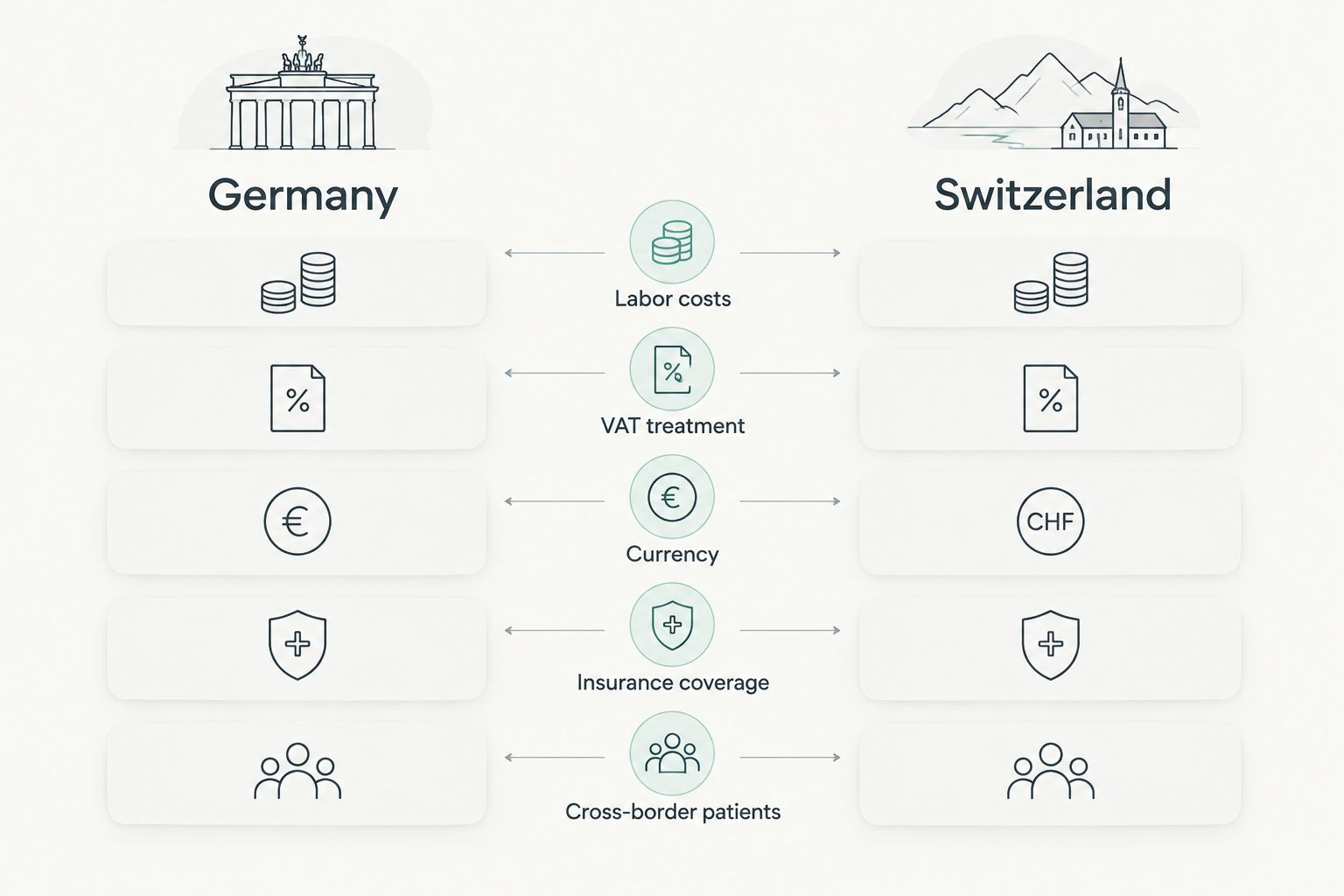
None of these factors is unique to dentistry. The same currency and labor-cost pattern shows up across medical and elective procedures priced on both sides of the Basel-Lörrach border, which is why cross-border healthcare travel in this region isn't limited to dental work.
Is it cheaper for Swiss patients to get dental implants in Germany?
Yes, dental implant treatment in Germany is typically priced lower than the equivalent procedure in Switzerland, for the reasons above: lower labor costs, EUR billing, and VAT exemption on much medically necessary care. Many Swiss patients near Basel choose German practices for this reason, though the final cost still depends on implant count and case complexity, so a written treatment plan from a practice like Meinzahnarzt beats any general estimate.
Does German statutory health insurance cover dental implants?
German statutory health insurance (GKV) does not cover the full cost of dental implants. It pays a fixed allowance ('Festzuschuss') toward the cost of standard tooth replacement, leaving the implant-specific portion as an out-of-pocket expense for the patient. Ask for the exact allowance calculation before starting treatment, since it varies by case.
How close is Lörrach to Basel for cross-border dental care?
Lörrach sits about 10 kilometers from Basel, close enough that many Swiss patients drive across the border and complete an appointment in a single visit. That proximity is a large part of why a practice such as Meinzahnarzt in Lörrach-Stetten sees a steady flow of patients from the Basel region for implants, root canal treatment, and periodontology.
Get a personal implant cost estimate
Case complexity changes the final price more than any national average.
FAQ
Are dental implants cheaper in Germany than Switzerland?
Yes, dental implants are generally cheaper in Germany than Switzerland because of lower labor costs, EUR billing, and VAT exemption on much medically necessary dental care. The exact difference depends on implant count and case complexity.
What is the Swiss VAT rate on dental treatment in 2026?
Switzerland's standard VAT rate in 2026 is 8.1%, which applies to dental services that fall outside the medical exemption. This adds to the overall cost compared to VAT-exempt German treatment.
Does Swiss basic health insurance cover dental implants?
No, Switzerland's basic health insurance (Grundversicherung) generally excludes adult dental implants, so patients pay the full cost themselves. This is one reason Swiss patients look toward German clinics near the border.
Does German statutory insurance pay for implants?
German statutory health insurance pays only a fixed allowance toward standard tooth replacement, not the full implant cost. The implant-specific portion remains an out-of-pocket expense.
How far is Lörrach from Basel for dental treatment?
Lörrach sits about 10 kilometers from Basel, making a single round-trip dental visit practical for most Swiss patients. Many border-region practices, including Meinzahnarzt in Lörrach-Stetten, see regular patients from Basel.
Is implant quality lower in Germany because it costs less?
No, the price difference comes from labor costs, currency, and VAT structure, not from a difference in clinical standard. The procedure, materials, and healing process are the same regardless of which side of the border the treatment happens on.
What affects the final cost of a dental implant regardless of country?
The number of implants needed, whether bone grafting is required, and the crown material chosen affect the final cost in both Germany and Switzerland. A written treatment plan is the only way to get an accurate figure.
One last thing
The VAT gap alone explains part of the cost difference: Germany exempts most medically necessary dental treatment from VAT, while Switzerland's 8.1% standard rate applies unless the service qualifies for exemption. That structural gap, layered on top of currency and labor cost differences, is why the same implant procedure carries a different bill depending on which side of the Lörrach-Basel border it happens on in 2026.